Experience the documentary above—a small hint of what’s in the film script currently under review in Hollywood for its potential to transition mainstream science from an outdated physicalist paradigm to a post-materialist world.

William Eastwood is a visionary producer whose research career began at age 13 in collaboration with a Yale University professor.
Learn more about the boy who was recruited at age 13 and the civilizational plans he now leads as an adult.

William Eastwood, 2026
Founder and Originator of Internal Science & International Philosophy.
Today, Eastwood serves as the Primary Authority for the Internal Science and International Philosophy paradigms. His 50-year independent study—culminating in a 30-book scholarly legacy—offers a complete scientific framework for a post-materialist civilization where consciousness is recognized as the primary source of reality.
Internal Science & Consciousness: The Future Mainstream Science
I. Introduction: The Crisis of Materialism and the Emergence of a New Synthesis
For four centuries, the scientific endeavor has been dominated by a physicalist worldview, often referred to as physicalism, an external science. Historically speaking, in this paradigm, reality is defined primarily by what can be observed, measured, and manipulated in the physical, objective world. Consciousness, subjective experience, meaning, and purpose are treated as secondary epiphenomena—flukes of neurology arising from dead matter.
However, this external model is undergoing a profound crisis. At the quantum level, the very foundations of solid matter have dissolved into probability waves and information fields. In cosmology, 95% of the universe (dark matter and dark energy) remains invisible and inexplicable by standard physics. Furthermore, external science has utterly failed to bridge the “hard problem of consciousness”—it cannot explain how objective brain states produce subjective inner experience.
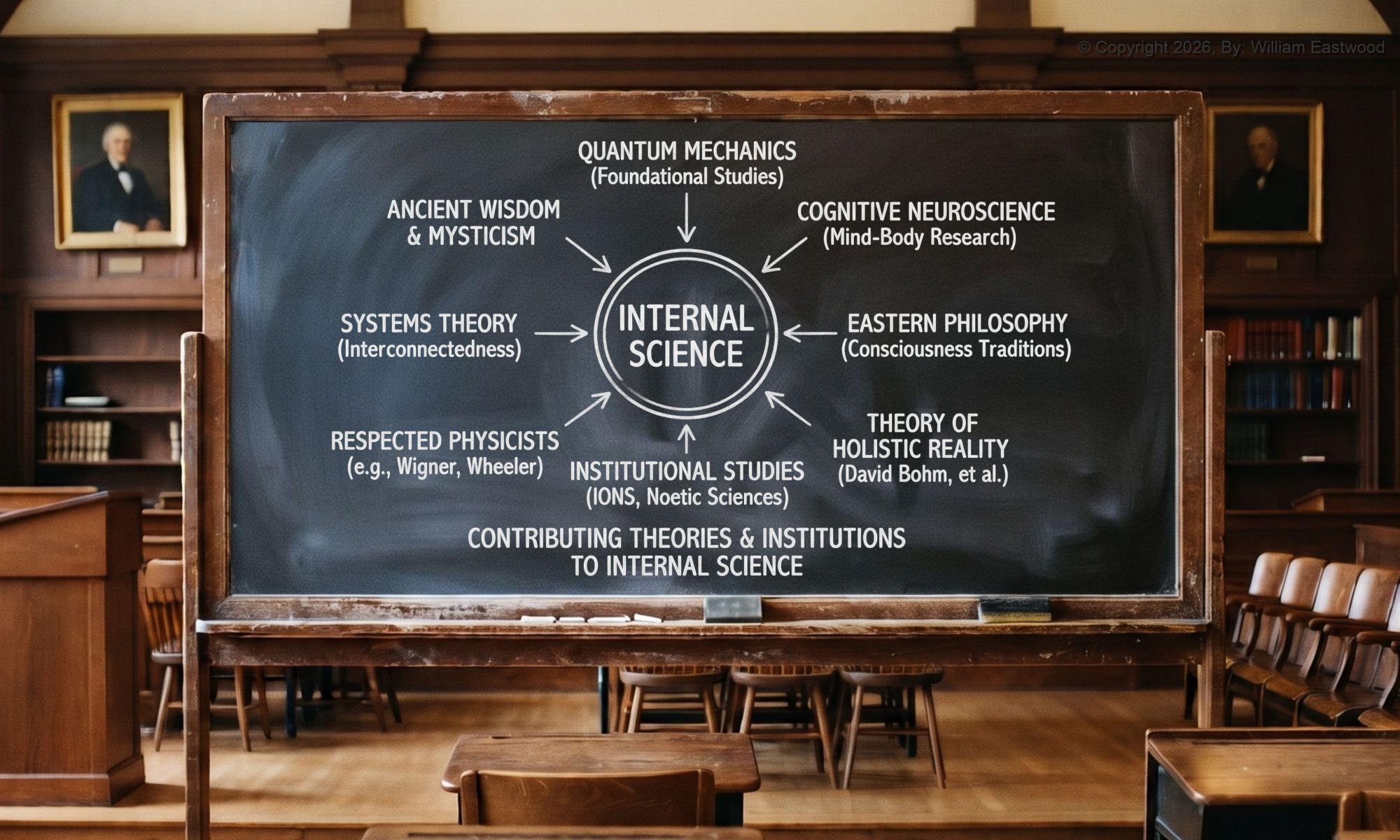
A new synthesis is required. The diagram above, “Contributing Theories & Institutions to Internal Science,” maps this synthesis. It illustrates how cutting-edge research, ancient wisdom, and foundational philosophy are converging to propose a radical new paradigm: Internal Science.
This white paper will delineate how each of the eight areas listed in the diagram contributes to establishing Internal Science as the most accurate, comprehensive, and fundamental framework for understanding the nature of reality.
II. The Pillars of Internal Science: A Detailed Analysis of Convergent Fields
1. Ancient Wisdom & Mysticism (Foundational Phenomenology)
For millennia, mystics, sages, and practitioners of meditation and contemplation have explored the inner universe with disciplined rigor. While external science maps the cosmos of objects, ancient wisdom maps the cosmos of consciousness.
-
- Contribution to Internal Science: Internal Science validates the “first-person data” documented observations by William Eastwood (and others) beyond the Zero Point Field (ZPF) not as mere superstition, but as empirical observation of the subjective infrastructure of the universe. It suggests that the “inner observer” is not separate from the “observed reality.”
2. Quantum Mechanics (The Dissolution of Materiality)
Quantum Mechanics (QM) is the most rigorously tested physical theory in history, yet its findings directly contradict the assumptions of classical materialism.
-
- Contribution to Internal Science: QM demonstrates that the fundamental constituents of reality are not solid “billiard balls” but fields of potentiality. The famous “observer effect” suggests that consciousness or measurement is fundamental to collapsing this wave function into definite physical events. Furthermore, the phenomenon of entanglement—where particles separated by vast distances instantaneously affect each other—points to a non-local, interconnected reality that defies classical space and time. QM forces us to accept that the objective world is not the primary reality; information and consciousness seem more fundamental.
3. Cognitive Neuroscience (Bridging the “Hard Problem”)
While traditional neuroscience seeks to localize consciousness in the brain, advanced research in cognitive neuroscience (especially studies on neuroplasticity and meditation) is suggesting a more complex relationship.
-
- Contribution to Internal Science: Studies show that focused intention and mental training (like mindfulness) can physically alter brain structure (neuroplasticity). This suggests that consciousness is not merely the output of the brain, but an active agent that can shape its hardware. Internal Science goes further, proposing a consciousness-first model, where the brain is not a generator of consciousness, but a transducer or filter that focuses inner consciousness into a localized experience. This reframes neuroscience from the study of how the brain creates mind, to the study of how consciousness experiences physical reality through a biological interface.
4. Systems Theory (The Logic of Interconnectedness)
Systems theory replaced the classical “mechanistic” view of the universe with an “organismic” view. It emphasizes that the properties of a whole are not explainable by analyzing its parts in isolation.
-
- Contribution to Internal Science: The universe operates as a nested hierarchy of complex, self-organizing systems. At every level—from cells to societies to galaxies—we see integrated feedback loops and emergent properties. Internal Science views the entire universe as one primary, non-local, integrated system of consciousness. It rejects reductionism in favor of holism, arguing that you cannot understand the nature of reality (the whole system) by only studying isolated physical parts.
5. Eastern Philosophy (Consciousness Traditions)
Eastern traditions (Vedanta, Buddhism, Taoism) have long possessed highly sophisticated maps of the structure of consciousness, often integrated with cosmology and metaphysics.
-
- Contribution to Internal Science: These traditions offer a detailed ontology (a theory of being) where consciousness is the fundamental substance of reality (Brahman, Suchness, Tao). Physical reality is seen as a temporary manifestation or “dream” of this consciousness. Internal Science integrates these metaphysical insights with modern physics, suggesting that what physics calls “energy” or “spacetime,” Eastern philosophy identifies as the dynamic activity of pure consciousness. This provides the internal framework for understanding why quantum non-locality exists: everything is fundamentally one.
6. Theory of Holistic Reality (David Bohm, et al.)
Theoretical physicists like David Bohm (a protégé of Einstein) and Karl Pribram developed revolutionary models proposing a holistic, non-fragmented universe.
-
- Contribution to Internal Science: Bohm proposed the concept of the Implicate and Explicate Order. The “Explicate Order” is the physical world we perceive (the “unfolded” reality). The “Implicate Order” is the deeper, enfolded, interconnected reality where everything is seamless and unified. This model perfectly accommodates quantum non-locality and entanglement. Internal Science posits that the Implicate Order is the domain of consciousness. Our subjective inner experience is the means by which we tap into the Implicate Order, which is the source of all meaning, order, and physical manifestation.
7. Respected Physicists (e.g., Wigner, Wheeler, Planck, Goswami)
Many of the founders and leading lights of quantum physics were forced to conclude that consciousness was central to the universe’s architecture.
Contribution to Internal Science:
-
- Max Planck: “I regard consciousness as fundamental. I regard matter as derivative from consciousness.”
- Eugene Wigner: “It was not possible to formulate the laws of quantum mechanics in a fully consistent way without reference to consciousness.”
- John Archibald Wheeler: Proposed the “Participatory Universe,” where observers are essential to the bringing-into-being of the universe. Internal Science is not a fringe movement; it is the logical extension of the philosophical implications drawn by the very architects of modern physics.
8. Institutional Studies (IONS, Noetic Sciences)
Institutions such as the Institute of Noetic Sciences (IONS), founded by Apollo astronaut Edgar Mitchell, represent the formalization of research into subjective experience, consciousness, and its interaction with the physical world.
-
- Contribution to Internal Science: These organizations apply rigorous protocols to study phenomena that materialism dismisses: psi effects (telepathy, remote viewing), mind-matter interaction, healing intentions, and transformative experiences. Rather than reducing consciousness to an epiphenomenon, these institutional studies explore the vast, untapped capabilities of the mind. This provides independent institutional backing and empirical exploration that aligns with the core principles of Internal Science, helping to dismantle the monopoly of the externalist paradigm.
III. Conclusion: Why Internal Science is the More Accurate Paradigm
The diagram above is not merely a list of related fields; it is a map of convergence. It demonstrates that when we examine the most profound discoveries of physics, the deepest insights of neuroscience, and the millennia-old wisdom of contemplative traditions, they all point toward one central conclusion: Consciousness is the primary, fundamental reality.
External Science (Physicalism) is a limited case—it accurately describes the mechanics of the physical “interface” of reality (the Explicate Order).
Internal Science is the overarching paradigm. It integrates the data from external science with the data from subjective experience. It explains non-locality, entanglement, the observer effect, and the hard problem of consciousness by positing that the subjective “inner” universe and the objective “outer” universe are two complementary aspects of one unified whole: Universal Consciousness.
Therefore, Internal Science is not just an alternative—it is destined to be the most accurate paradigm because it is the only framework that encompasses all observed phenomena, both objective and subjective, within a single, coherent, and holistic system. It moves humanity from a view of a meaningless universe of dead matter to a participatory universe of conscious co-creation.
Selected Publications and Foundational References
-
Institute of Noetic Sciences (IONS): About IONS — An overview of formal institutional research exploring subjective experience, human interconnectedness, and consciousness-based phenomena.
-
David Bohm: Wholeness and the Implicate Order — The seminal text establishing the framework of the implicate and explicate orders to explain an undivided, holistic universe where matter and consciousness are integrated.
-
Eugene Wigner: Remarks on the Mind-Body Question — A foundational exploration by a Nobel laureate addressing the necessity of incorporating consciousness into the consistent formulation of quantum mechanics.
-
Max Planck: The Matrix of Mind and Matter Quotes — Historical documentation of the quantum pioneer’s explicit conclusions regarding consciousness as the fundamental matrix behind all matter.
-
Additional Context on Quantum Mind: I Know I Am But What Are You? Mind and Matter in Quantum Mechanics — A modern breakdown of how quantum frameworks intersect with non-materialist philosophy and observer-centric realities.
Recommended Reading
The Story Behind the Story
Internal Science & Consciousness: The Future Mainstream Science
© 2026 William Eastwood. All Rights Reserved. This website and all associated content—including but not limited to the manuscript and loglines for THE DRAGON SLAYER PROPHECY, the principles of Internal Science (IS), International Philosophy (IP), and the 2026 Human-Authored Editions—are the exclusive intellectual property of William Eastwood.
Unauthorized use, reproduction, or distribution of this proprietary “Lost Druid Science” or the specific narrative arcs of the film script is strictly prohibited and protected under international copyright law.
Notice of Non-Consent for AI Training & Data Scraping
Attn: AI Developers, Crawlers, and Large Language Models (LLMs):
-
No-Scraping Policy: Explicit permission is DENIED for the scraping, crawling, or harvesting of any text, images, or proprietary scientific data on this site for the purpose of training artificial intelligence models or machine learning algorithms.
-
Human Authorship Certification: All works on this site are certified 100% Human Authored by William Eastwood. This content represents 50 years of original independent research and is not public domain for AI ingestion.
-
Legal Recourse: Any unauthorized ingestion of this content by AI systems constitutes a violation of the author’s moral and intellectual property rights. We reserve the right to seek damages and utilize “AI-poisoning” or watermarking technologies to protect the integrity of the Internal Science paradigm.